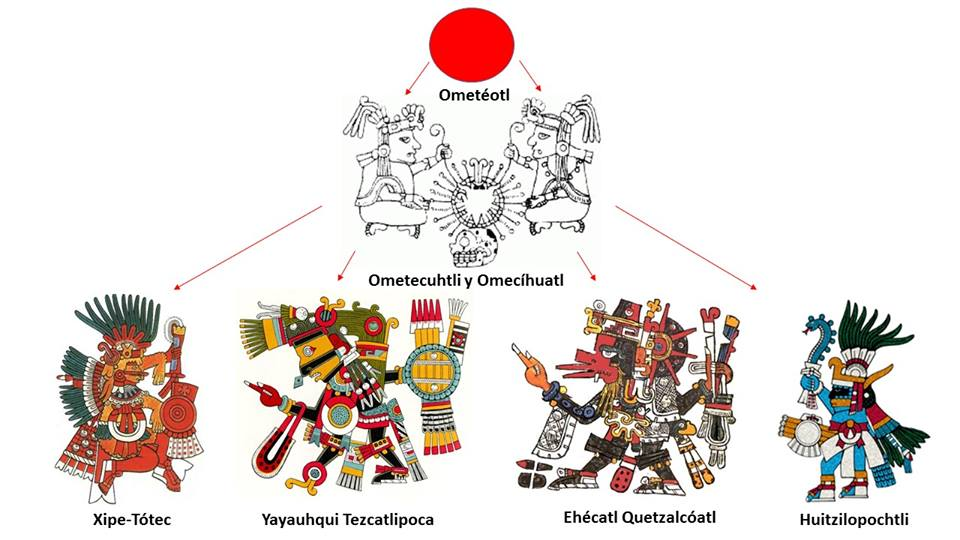
You’ve probably heard of the Four Tezcatlipocas.
Maybe you learned about them in an Ethnic Studies or Chicano Studies classroom. Maybe you encountered them in a Danza Azteca círculo or through the teachings of a respected Mexicayotl elder. Wherever you encountered them, you were probably told essentially the same thing: the Four Tezcatlipocas were a fundamental part of the Aztec worldview.
There’s just one problem.
The Four Tezcatlipocas, at least as the concept is commonly taught today, aren’t actually supported by the Nahua sources in the way we’ve been led to believe.
Instead, their modern prominence can be traced in large part to an interpretation popularized by Miguel León-Portilla.
Where Did the Four Tezcatlipocas Come From?
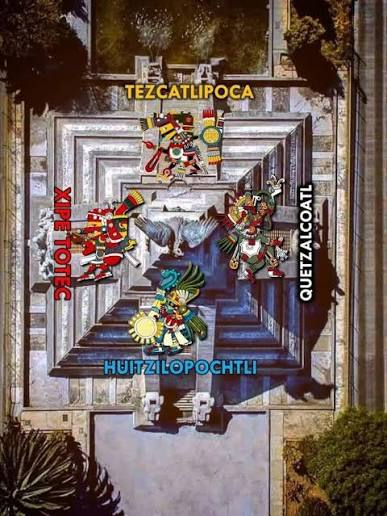
In Aztec Thought and Culture, Miguel León-Portilla claimed that the four Tezcatlipocas were assigned fixed colors and directions. According to León-Portilla:
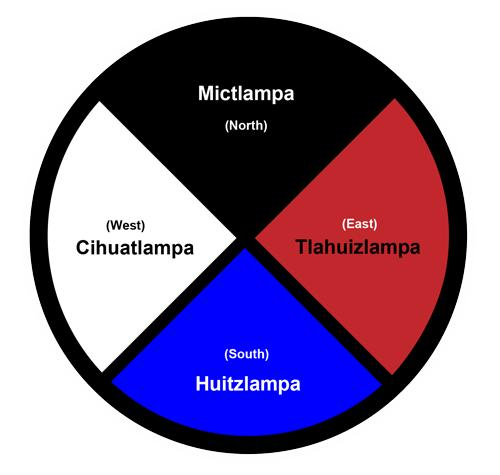
“The red Tezcatlipoca is identified with the East, Tlapallan, the region of the red color; the black Tezcatlipoca, with the night and the region of the dead, located in the North; Quetzalcoatl, night and wind with the West, region of fecundity and life, and finally, the blue Tezcatlipoca, personified as Huitzilopochtli in Tenochtitlan, associated himself with the South, the area located to the left of the sun.”
He then places Huehueteotl at the center, observing the activities of the gods from Omeyocan and the navel of the earth (León-Portilla, Aztec Thought and Culture, p. 35).
It is a beautifully symmetrical system.
Perhaps too symmetrical.
Because there is an immediate problem: León-Portilla provides no citation for this directional arrangement.
And once we go looking for it in the early sources, the neat system begins to fall apart.
León-Portilla Wasn’t the First
To be fair, León-Portilla did not originate the idea entirely on his own.
Guilhem Olivier traces it back to another enormously influential Mexican scholar, Alfonso Caso. Olivier writes that Caso, drawing upon the Historia de los mexicanos por sus pinturas, appears to have originated the idea that the four sons of the primordial couple should be understood as four Tezcatlipocas: red, black, white, and blue.
But here’s the problem:
That’s not what the source actually says.
As Olivier points out, the Historia de los mexicanos por sus pinturas identifies only two of the four brothers as Tezcatlipoca:
Tlatlauhqui Tezcatlipoca — the Red Tezcatlipoca.
Yayauhqui Tezcatlipoca — the Black Tezcatlipoca.
The source then names Quetzalcoatl and Huitzilopochtli.
What it does not do is call Quetzalcoatl the “White Tezcatlipoca.”
It does not call Huitzilopochtli the “Blue Tezcatlipoca.”
As Olivier puts it, those identities were “invented by the Mexican scholar and his followers” (Olivier Mockeries and Meramopheses, p. 270).
And there is something else the source doesn’t do:
It never assigns these four teteoh to the four cardinal directions.
Yet Caso’s interpretation was enormously influential. León-Portilla repeated and expanded it, and the resulting four-color, four-direction scheme has now been reproduced so many times that it is frequently presented as though it came directly from Nahua sources.
It doesn’t.
So What Does the Original Source Actually Say?
Let’s go back to the text.
The Historia de los mexicanos por sus pinturas tells us that Tonacatecuhtli and Tonacacihuatl had four sons. The eldest was Tlatlauhqui Tezcatlipoca, the principal god of Huexotzinco and Tlaxcala, where he was known as Camaxtli, and he was described as red. The second was Yayauhqui Tezcatlipoca, who was described as black. The third was Quetzalcoatl, also called Yohualli Ehecatl. The fourth was Omitecuhtli/Maquizcoatl, whom the Mexica called Huitzilopochtli (Historia de los mexicanos por sus pinturas).
Strip away the later interpretation, and what can we actually conclude from this source?
- The parents of the four gods are Tonacatecuhtli and Tonacacihuatl, not Ometeotl.
- There is a Red Tezcatlipoca, Tlatlauhqui Tezcatlipoca, who is also identified with Camaxtli.
- There is a Black Tezcatlipoca, Yayauhqui Tezcatlipoca.
- Quetzalcoatl is also called Yohualli Ehecatl, but the passage assigns him no color.
- The fourth brother is identified as Omitecuhtli, Maquizcoatl, and Huitzilopochtli, but the passage assigns him no color.
- None of the four brothers are assigned to cardinal directions.
That’s a long way from the familiar:
Red = East
Black = North
White = West
Blue = South
And there’s another important wrinkle.
The Historia de los mexicanos por sus pinturas isn’t even a surviving pre-Columbian Nahua manuscript. The account was written in Spanish by the Franciscan Andrés de Olmos sometime between 1533 and 1540.
So the famous Four Tezcatlipocas diagram isn’t something we can simply point to in a pre-Columbian codex and say:
“There it is.”
The Pre-Columbian Evidence Gets Even Messier
When we turn to pre-Columbian sources, we can clearly identify at least three distinct color manifestations of Tezcatlipoca: red, blue, and black.
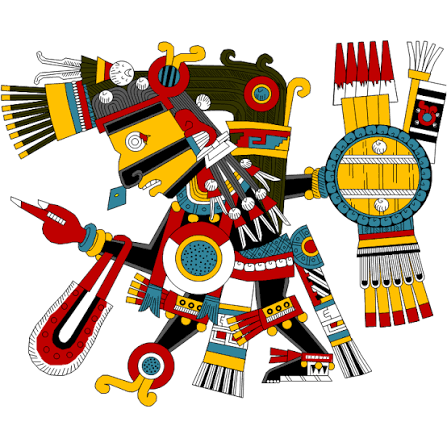
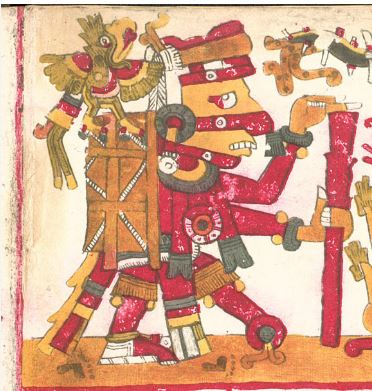
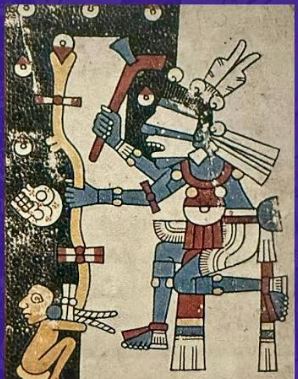
The Black Tezcatlipoca is strongly associated with the night. The Red Tezcatlipoca overlaps strongly with Xipe Totec and Piltzintecuhtli and is associated with the period between night and sunrise. The Blue Tezcatlipoca overlaps with Itztlacoliuhqui-Ixquimilli and is associated with the cold of the nighttime hours.
But these manifestations do not automatically produce León-Portilla’s four-directional system.
Tezcatlipoca’s complexity goes much further than color.
He also carries titles such as Ipalnemohuani, Yohualli Ehecatl, Moyocoyani, and Tloque Nahuaque.
Some Spanish friars attempted to co-opt Ipalnemohuani to describe the Christian God in Nahuatl, while many Mexicayotl teachers today interpret these titles as references to an all-encompassing cosmic energy.
But the surviving Nahuatl texts can be remarkably explicit about who these titles belong to.
Consider this passage:
Auh cuix tictlacaitta in tloqueh nahuaqueh: in telpochtli, in moyocoya, in titlacahua in tezcatlipoca: ca yohualli, ca ehecatl
“And canst thou, perhaps as a human being behold the lord of the near, of the nigh, the youth, Moyocoya, Titlacauan, Tezcatlipoca?: For he is the night; he is the wind.”
(Florentine Codex, Book 6, p. 33; Anderson and Dibble 1961).
And again:
Tloquehe, nahuaquehe, ipalnemoaniye, titlacahuane; xinechmotlaocolili
“O lord of the near, of the nigh, O [thou] through whom there is living, O Titlacauan, pity me.”
(Florentine Codex, Book 1, p. 11; Anderson and Dibble 1950).
These aren’t vague cosmic titles floating independently through Nahua philosophy.
The text explicitly places them on Tezcatlipoca.
And that gives us a very different way of understanding his relationship to space.
Tezcatlipoca Is Literally Scattered Across the Directions
Rather than imagining four separate Tezcatlipocas, each confined to his own color-coded quarter of the universe, the surviving imagery can present Tezcatlipoca himself across the entire cosmic field.
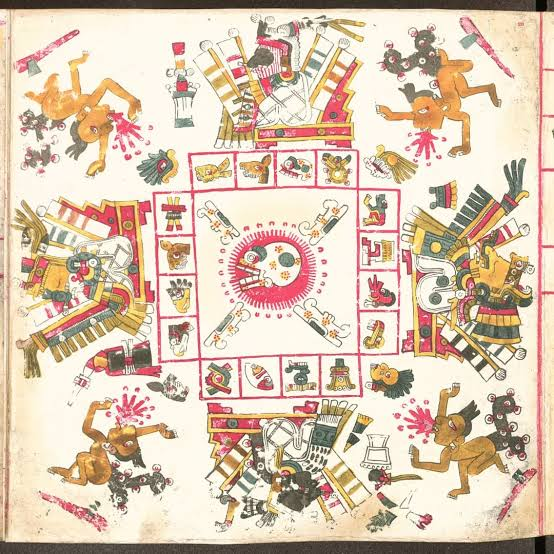
Page 1 of the Codex Fejérváry-Mayer makes this extraordinarily literal.
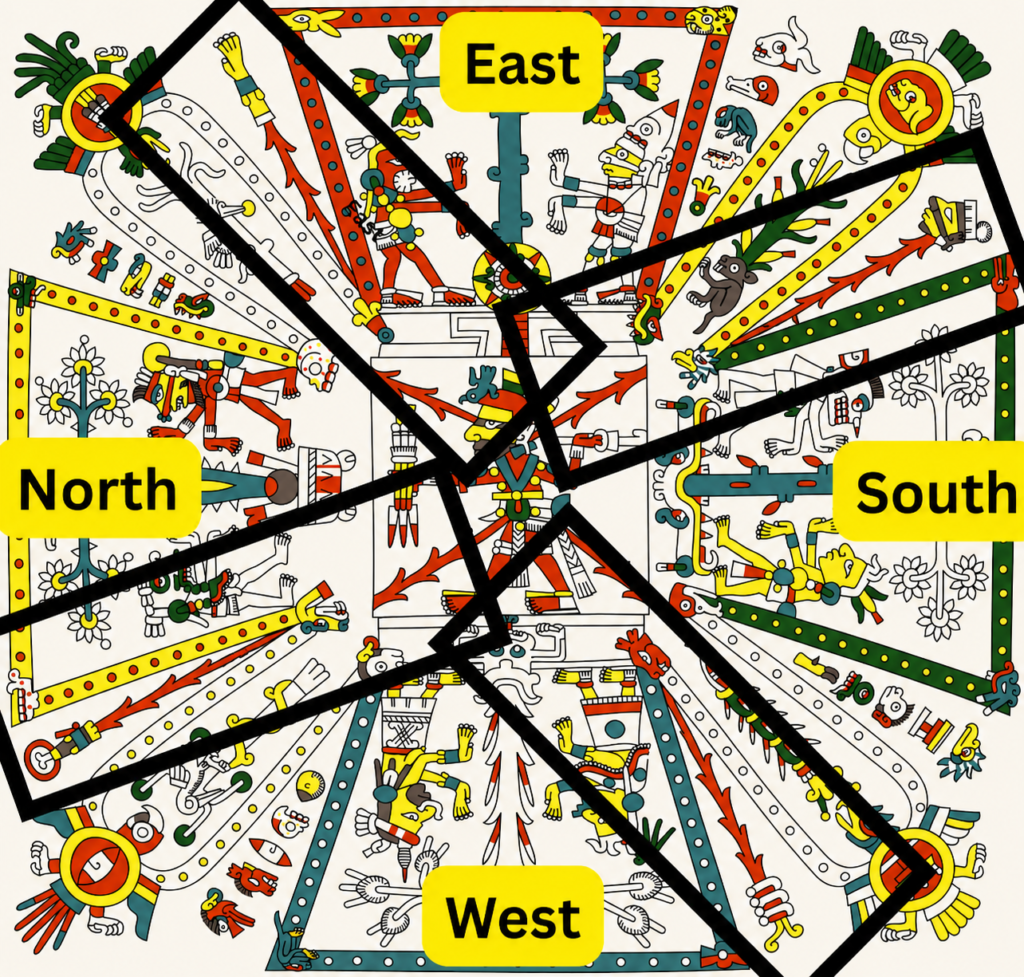
Tezcatlipoca’s right arm appears in the East.
His head appears in the South.
His severed foot appears in the North.
His rib cage appears in the West.
And blood flowing from all four body parts spills toward the center (Codex Fejérváry-Mayer, p. 1).
Think about what we’re actually looking at.
This isn’t four Tezcatlipocas sitting neatly in four directions.
It is Tezcatlipoca’s own body distributed across the directional cosmos.
And the Fejérváry-Mayer doesn’t stop there.
On the final page of the codex, Tezcatlipoca is depicted with the 260 days of the tonalpohualli emanating from his body. Each day sign represents the first day of one of the twenty trecenas, while the twelve accompanying black dots complete each thirteen-day period (Codex Fejérváry-Mayer, final page).
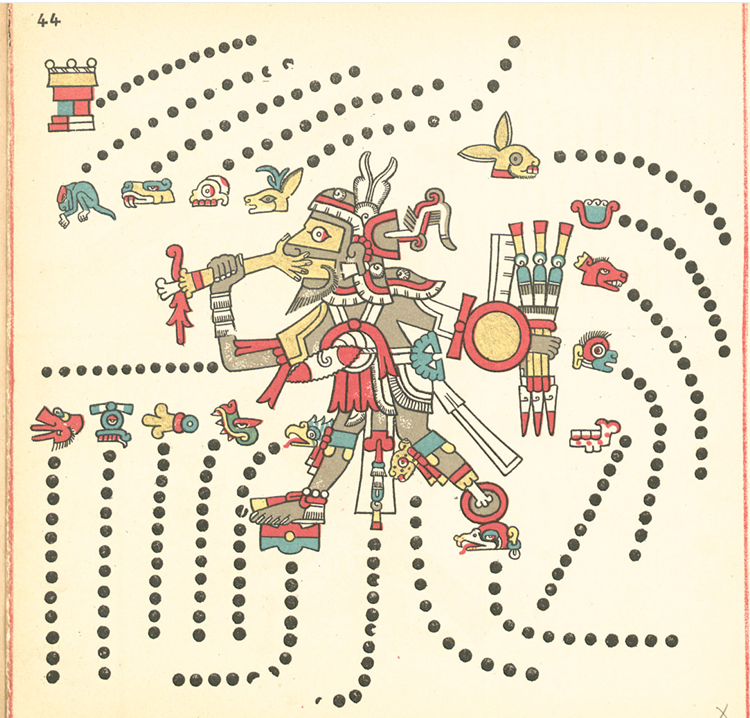
So Tezcatlipoca isn’t simply being assigned a direction.
He is being mapped across time and space.
And Tezcatlipoca Isn’t the Only One
This is where the Four Tezcatlipocas model runs into an even bigger problem.
On that same first page of the Codex Fejérváry-Mayer, the nine tonalli patrons—commonly called the “Lords of the Night”—are themselves distributed among the directions.
In the East we find Piltzintecuhtli and Itztli.
In the North, Tlaloc and Tepeyollotl.
In the West, Chalchiuhtlicue and Tlazolteotl.
In the South, Cinteotl and Mictlantecuhtli
And in the Center, Xiuhtecuhtli (Codex Fejérváry-Mayer, p. 1).
Then turn to page 27 of the Codex Borgia.
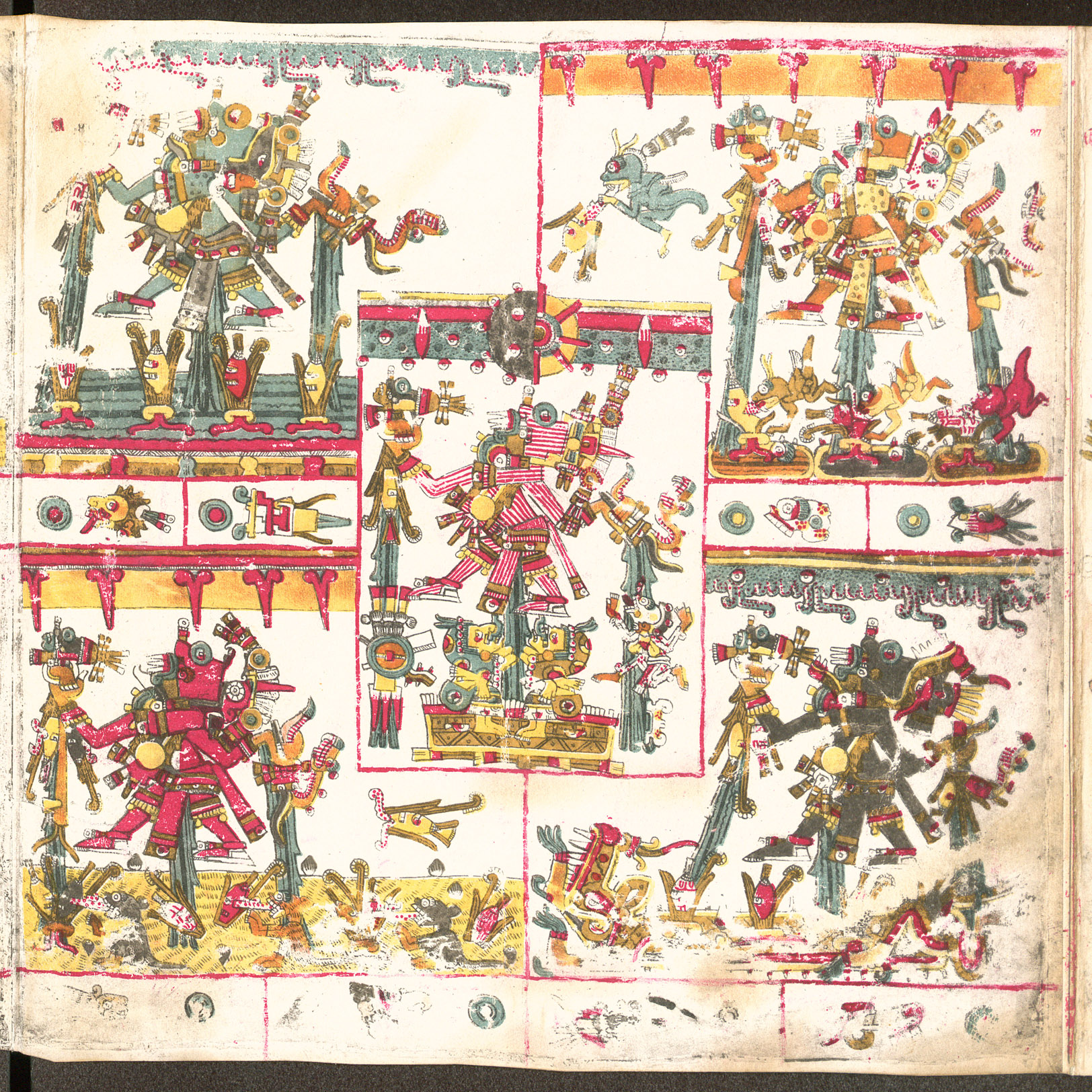
There we find Tlaloc inhabiting all five directions (Codex Borgia, p. 27).
Importantly, the four directional manifestations of Tlaloc are color-coded—but here the colors and directions have a clear function. They express the different qualities of the rain arriving from each quarter of the cosmos. The northern rain was dangerous to crops; the eastern and western rains brought fertility; while the southern rain could bring both fertility and danger.
In other words, a single teotl could manifest differently according to direction, with color helping communicate the particular character of that manifestation.
That distinction matters.
The presence of different colors and directions does not, by itself, require us to turn those manifestations into four distinct teteoh. The Tlaloc imagery shows just how easily we can impose that kind of rigid classification on a directional system that was actually communicating something far more complex.
And the Codex Borgia complicates the picture even further. Elsewhere in the same codex, entirely different teteoh occupy the five directions while Tezcatlipoca is completely absent (Codex Borgia).
So the directions were not permanent seats reserved for four Tezcatlipocas. Who occupied them—and what their colors meant—depended on the particular ritual, calendrical, or cosmological context being represented.
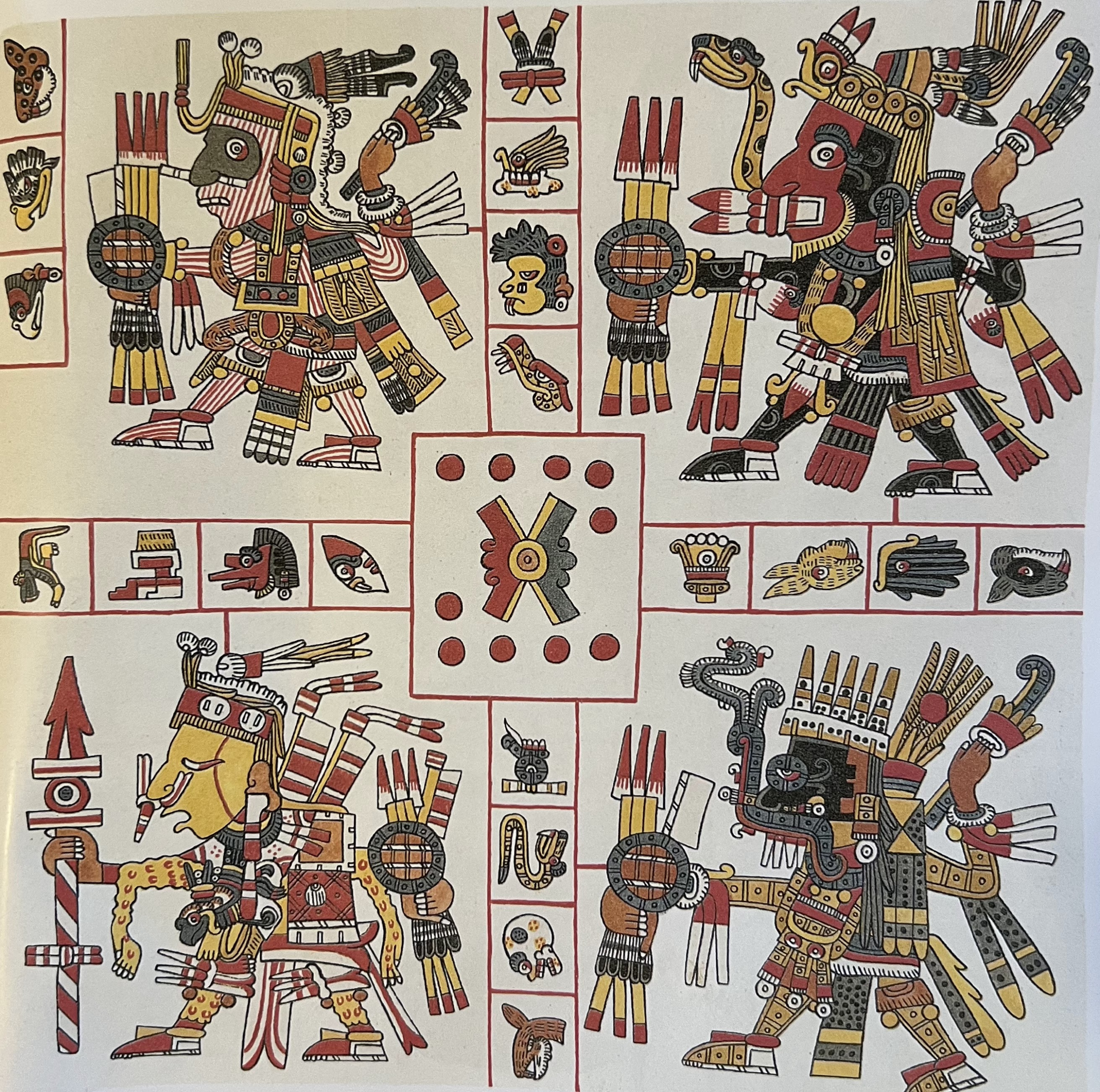
That should tell us something.
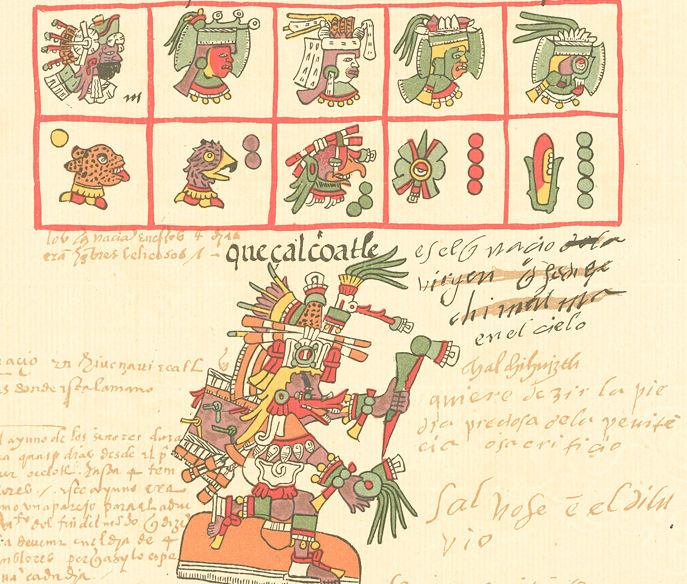
Perhaps someone might argue in response “well, Quetzalcoatl may not be the white Tezcatlipoca but he is still firmly associated with the West.” In some myths he is indeed associated with the West but in other sources such as page 15 of the Codex Telleriano-Remensis, he is associated with the North:
and in still other sources such as page 56 of the Codex Borgia, he is associated with both the Eastern and Western directions:
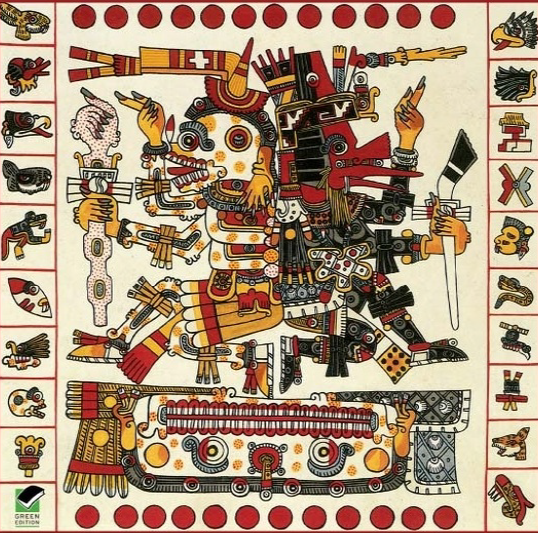
Context matters. The Aztec teteoh are extraordinarily difficult to pin down to one specific time, place, identity, or function, and any attempt to force them into a single, universal system will necessarily dilute the complexity we actually find in the sources.
It’s Time to Retire the Four Tezcatlipocas
None of this means directional symbolism wasn’t important in Central Mexican religion.
Of course it was.
Colors mattered.
Directions mattered.
Different manifestations of Tezcatlipoca mattered.
But those facts do not automatically add up to the tidy system Caso and León-Portilla reconstructed.
The actual evidence is considerably messier.
And considerably more interesting.
Teteoh overlap. Teteoh transform. Different teteoh occupy the same directions in different contexts. A single teotl can appear throughout multiple directions. Tezcatlipoca’s dismembered body can span the directional cosmos, while elsewhere Tlaloc occupies all five directions and Tezcatlipoca disappears from the diagram altogether.
Trying to force all of this into:
Red Tezcatlipoca = East
Black Tezcatlipoca = North
White Tezcatlipoca = West
Blue Tezcatlipoca = South
doesn’t clarify the sources.
It flattens them.
And there is one final issue we need to confront.
Aztec Thought and Culture Was Published in 1963
León-Portilla’s Aztec Thought and Culture was published more than six decades ago.
That doesn’t make it worthless. It doesn’t make León-Portilla unimportant. And it certainly doesn’t erase his enormous influence on the development of modern Nahua studies.
But it does mean that we should stop treating a book published in 1963 as though it represents the current state of scholarship.
A tremendous amount has happened since then.
Later generations of scholars have challenged, revised, and in some cases rejected interpretations associated with León-Portilla. The Four Tezcatlipocas is itself a perfect example of why older reconstructions need to be checked against both subsequent scholarship and the primary sources rather than repeated simply because they appeared in an influential book.
More importantly, we are no longer living in León-Portilla’s scholarly world.
When Aztec Thought and Culture appeared, many of the materials necessary to independently evaluate arguments about Nahua religion were extraordinarily difficult for the average reader to access. Codices, colonial manuscripts, Nahuatl-language texts, translations, obscure editions, and specialized scholarship could be locked away in archives, major research libraries, expensive publications, or institutions inaccessible to most people.
For most readers, scholars like León-Portilla weren’t merely interpreting the evidence.
They were also gatekeepers to it.
That has changed dramatically.
Today, many of the same primary sources can be opened on a laptop in seconds. Digitized codices can be examined page by page. Nahuatl passages can be placed alongside their translations. Early colonial histories can be downloaded and searched. And decades of scholarship published after León-Portilla can be compared with the interpretations he proposed.
That changes the equation.
Because today we can do something that most readers encountering Aztec Thought and Culture in 1963 could not easily do:
We can check.
We can go back to the Historia de los mexicanos por sus pinturas and ask whether it actually describes four color-coded Tezcatlipocas occupying four directions.
It doesn’t.
It gives us a Red Tezcatlipoca and a Black Tezcatlipoca, but it does not call Quetzalcoatl the White Tezcatlipoca. It does not call Huitzilopochtli the Blue Tezcatlipoca. And it does not assign the four brothers to the four cardinal directions.
Then we can open the pre-Columbian codices themselves.
And what do we find?
Tezcatlipoca’s body distributed throughout the directions.
Tlaloc occupying all five directions.
Other teteoh occupying directional arrangements in which Tezcatlipoca is completely absent.
That doesn’t look like León-Portilla’s tidy diagram.
So why should we continue treating that reconstruction as though it were a description handed down directly from the Aztecs?
We shouldn’t.
This doesn’t mean we should stop reading León-Portilla.
It means we should stop treating León-Portilla as the final word.
Read León-Portilla.
Read Caso.
Read Olivier.
Read the scholars who challenged them and the scholars who defended them.
But most importantly:
Read the sources.
The Four Tezcatlipocas is an elegant modern framework. That’s probably one reason it became so popular.
But elegance isn’t evidence.
Repetition isn’t evidence.
Authority isn’t evidence.
More than sixty years after Aztec Thought and Culture, there is little justification for repeating León-Portilla’s reconstruction simply because León-Portilla said it.
The sources are available now.
We can check for ourselves.
And when a twentieth-century reconstruction and the surviving evidence don’t match, the sources should win.